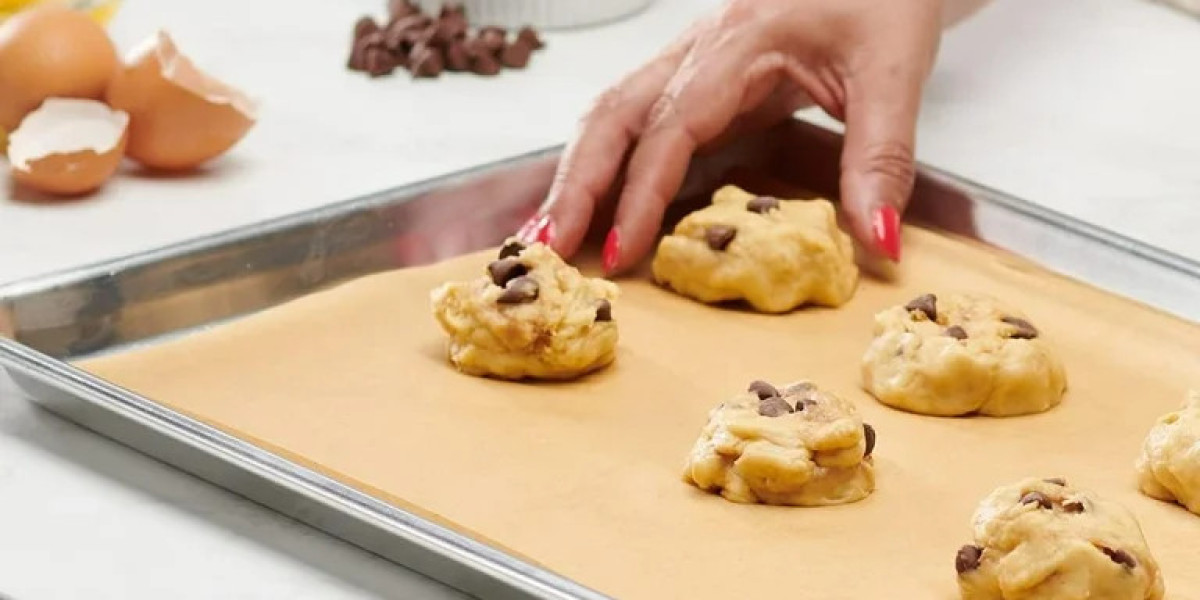

In commercial baking and food preparation, the paper placed between food and equipment needs to provide dependable handling characteristics while remaining suitable for the intended process. Parchment Paper is produced through a combination of carefully selected paper substrates and surface treatment, with the final characteristics influenced by coating, converting, inspection, and packaging. Understanding these manufacturing factors helps buyers connect material properties with practical application requirements.
The base paper forms the structural foundation of the finished material. Its surface condition, strength, flexibility, and consistency can influence subsequent coating and converting operations. A uniform substrate provides a more stable foundation for surface treatment, while variations in the paper can create differences during later processing. For manufacturers, raw material inspection is therefore an important part of establishing production consistency.
Silicone coating is commonly used to create a release surface on food paper. The treated surface can help reduce adhesion between food and paper, which is useful when handling dough, pastries, cookies, roasted foods, and other prepared products. The effectiveness of the finished surface depends partly on coating uniformity. Consistent application helps create a more predictable interaction between food and the paper during preparation and baking.
The relationship between the substrate and coating is also important. The coating needs to remain appropriately attached to the paper while providing the intended surface characteristics. Production conditions, equipment operation, material preparation, and inspection procedures all contribute to this balance. Monitoring the coating process can help manufacturers identify irregularities and maintain more consistent results between production batches.
Different applications require different formats. Bakeries may prefer pre-cut sheets for trays and preparation stations, while food manufacturers or distributors may require rolls that can be cut according to their own workflows. Specialized downstream processing can also produce liners for particular cooking equipment. This flexibility allows coated food paper to serve a broad range of food preparation environments.
Converting technology plays an important role in creating these formats. Slitting can divide larger rolls into narrower widths, while cutting can produce sheets with defined dimensions. Accurate converting helps maintain consistent sizes and clean edges. In busy commercial kitchens, predictable dimensions can simplify preparation and reduce the need for repeated adjustments when paper is used across large numbers of trays or food portions.
Quality management should cover the entire production process rather than only the finished product. Incoming material checks, coating inspection, dimensional checks, finished-product review, and packaging inspection each address different potential sources of variation. A coordinated quality process provides manufacturers with greater control over the material from the beginning of production through shipment.
Food-contact applications also require product-specific consideration. Buyers should evaluate documentation according to the particular paper, coating, intended use, and destination market. Requirements can vary between countries and regions, so relevant compliance information should be confirmed for the exact product rather than assumed from a general statement.
Packaging helps protect finished sheets and rolls after production. During transportation and storage, paper can encounter moisture, dust, pressure, and repeated handling. Appropriate packaging can help preserve the physical condition of the material and reduce unnecessary exposure to external conditions. For international purchasing, packaging quality is therefore an important part of the overall supply process.
From a procurement perspective, evaluating food paper involves more than comparing prices. Buyers can consider substrate consistency, coating technology, available formats, converting precision, inspection procedures, packaging methods, and documentation. These factors provide a broader understanding of whether a material is appropriate for a specific baking or food preparation workflow.
Manufacturing technology continues to connect paper materials with practical food-processing requirements. Stable substrates provide the foundation, coating creates the functional surface, and converting equipment produces formats suitable for different users. Inspection and packaging then help maintain the material's condition throughout production and distribution. Guanghe provides silicone-coated food paper and related products, with available solutions presented at https://www.guanghepaper.com/product/ for businesses evaluating food paper according to their specific applications.